How it works
Four or five minutes end to end, most of it waiting. Nothing to pay until you have read enough of the document to judge it.
The three steps
- Tell us about the job
Your trade, then the job — ten common jobs per trade, or describe your own. The kind of place it is, how long it takes, the site address and postcode, your business name and a contact number. About a minute on a phone. No account, no card.
The more specific you are, the more specific the document. “Strip and re-tile a pitched roof” produces a good RAMS. Adding “two storey, over a conservatory, terraced street with no parking” produces a better one, because those are the hazards that catch people out.
- It gets written, and you watch
The page shows each section as it is reached, with a timer. The title, the scope of works and the first three hazards appear in full, exactly as they will be in the document — controls, scoring and all. Later hazards appear by name, locked.
You can lock your phone or close the tab. The document carries on being written on our side, and the link takes you back to it.
- Unlock it for £29
Card payment through Stripe. The rest of the document unlocks on the same page straight away, and the Word file and PDF arrive by email a moment later. You can download them again from the same link for 12 months.
£29 when you unlock it. Nothing to pay until you have read the preview.
The wait, honestly
- First 20 seconds
- Nothing visible. The job is being worked out before a word is written.
- 1 to 2 minutes
- The document streams out, section by section. This is the bulk of the wait.
- If a check fails
- It is written again with the problems fed back, which adds about two minutes. The page tells you that is what is happening.
- If it keeps failing
- After three goes it is thrown away rather than sold to you. Nothing is charged, because you had not paid.
Two to three minutes is the normal case. Slower than downloading a blank template, and a great deal faster than writing one at nine at night for a job starting Monday.
What is in the document
Eleven sections, in the order a principal contractor reads them.
- Cover and scope of works — your company, the site, the date, and what the job includes, in sequence, with any assumptions stated.
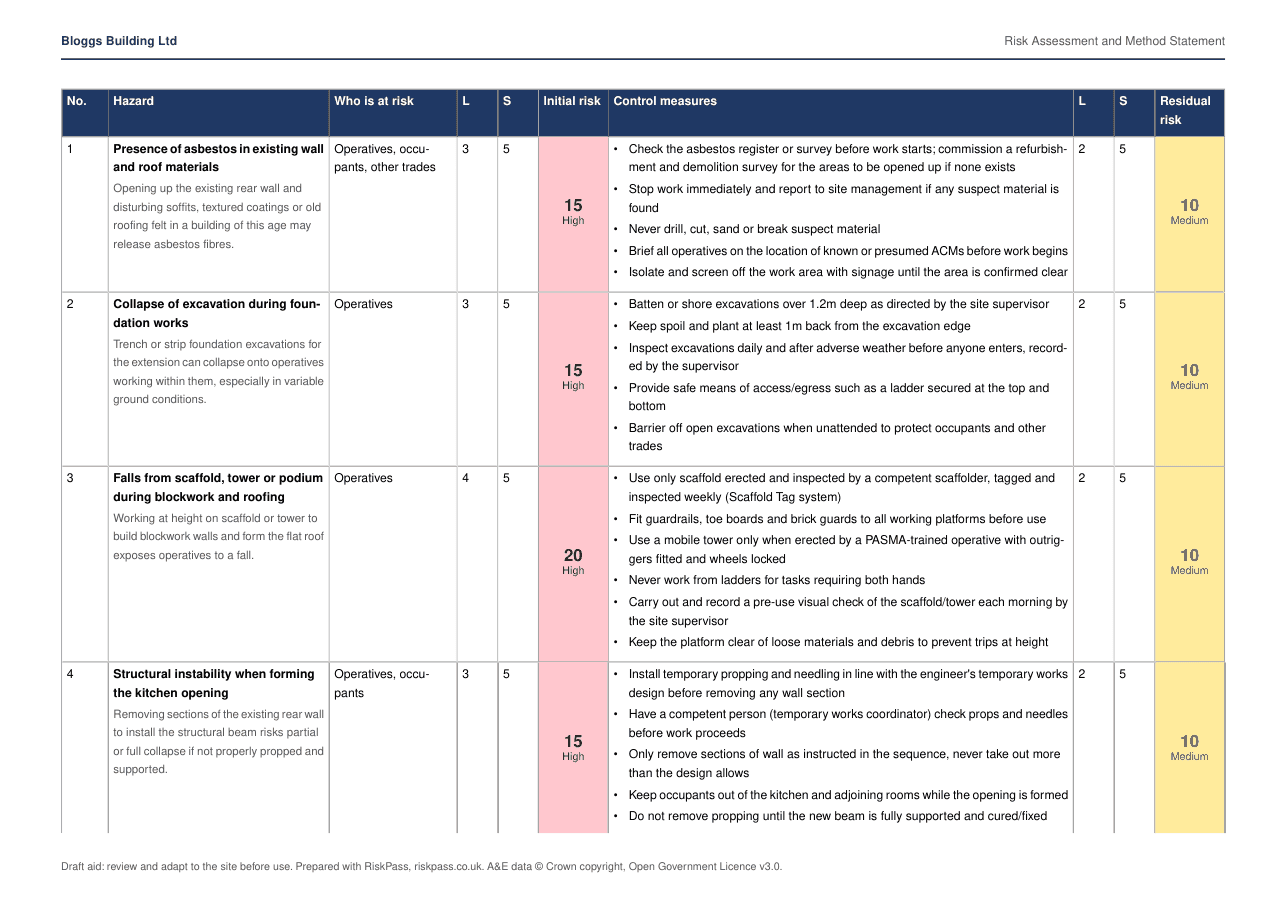
- Risk assessment — a 5×5 matrix key, then every hazard with who is at risk, a score before controls, the control measures, and a lower score after them.
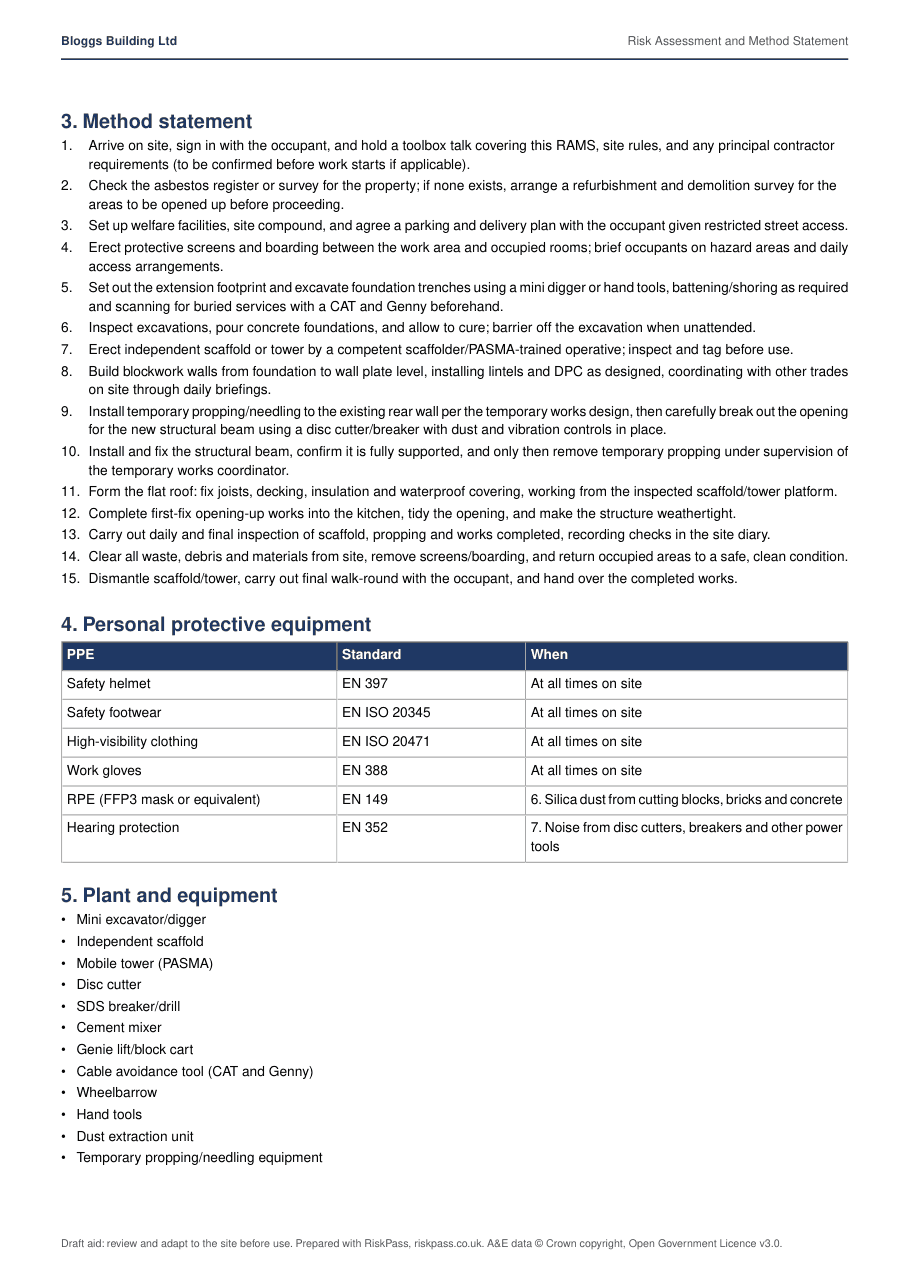
- Method statement — at least ten numbered steps in the order the work is actually done, from arrival to handover.
- PPE — what is worn throughout and what is task-specific, each with its EN standard and when it is needed.
- Plant and equipment — what is on site for this job.
- COSHH — substances used or produced, how they arise, the hazard and the control.
- Permits — hot works, permit to dig, electrical permit to work, confined space entry, where the job needs them.
- Emergency arrangements — raising the alarm, calling 999 with the site address and postcode, and the nearest A&E, worked out from your postcode.
- Rescue plan — only where a fall arrest harness is used, because a suspended casualty cannot wait for an ambulance.
- First aid — the kit, the first-aider, and the nearest A&E again.
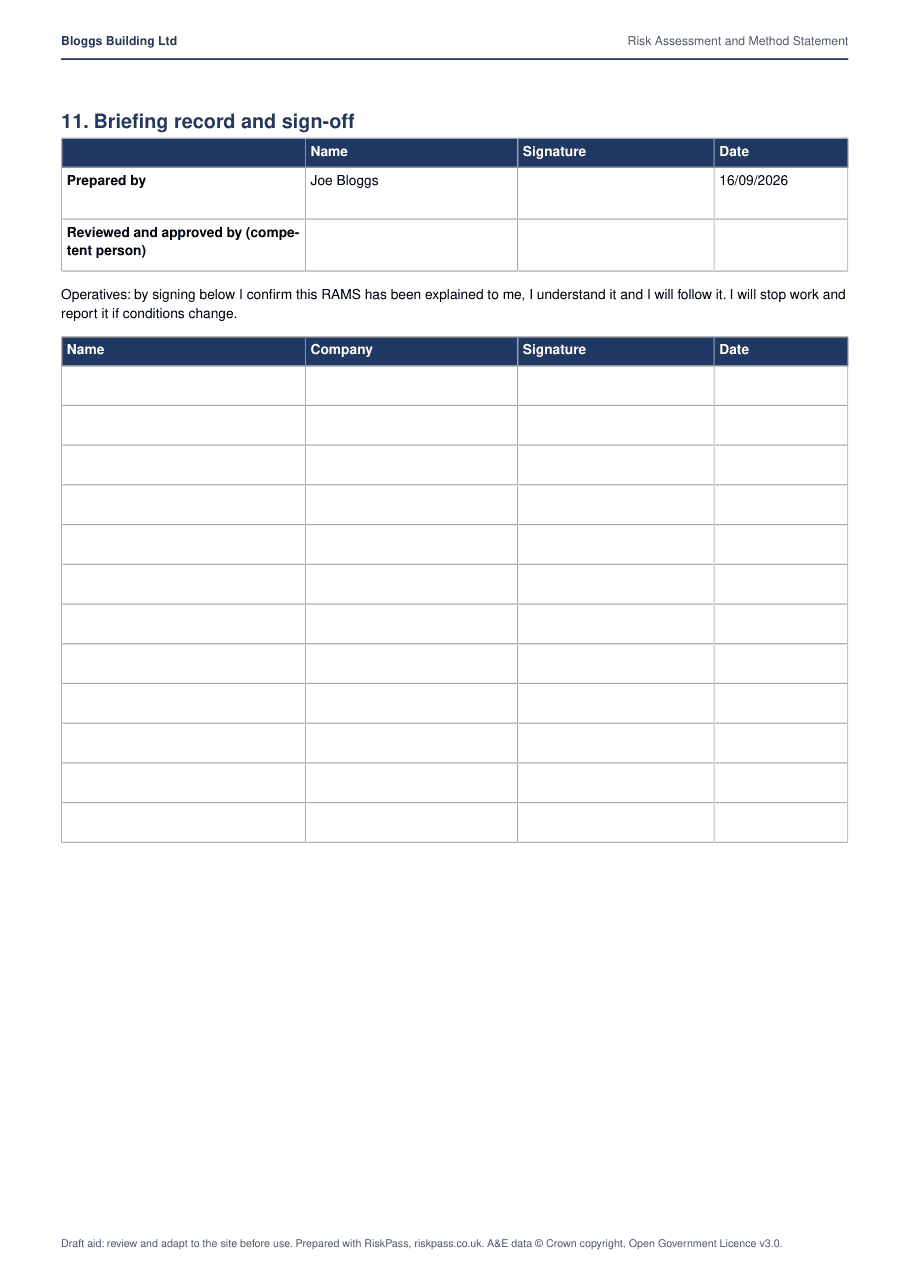
- Legislation, briefing record and sign-off — the regulations that apply and why, then a sheet for twelve operatives to sign.
Pages from a real document
These are pages of the example document, not mock-ups. It is a single-storey rear extension on an occupied 1950s house, for a made-up building firm.
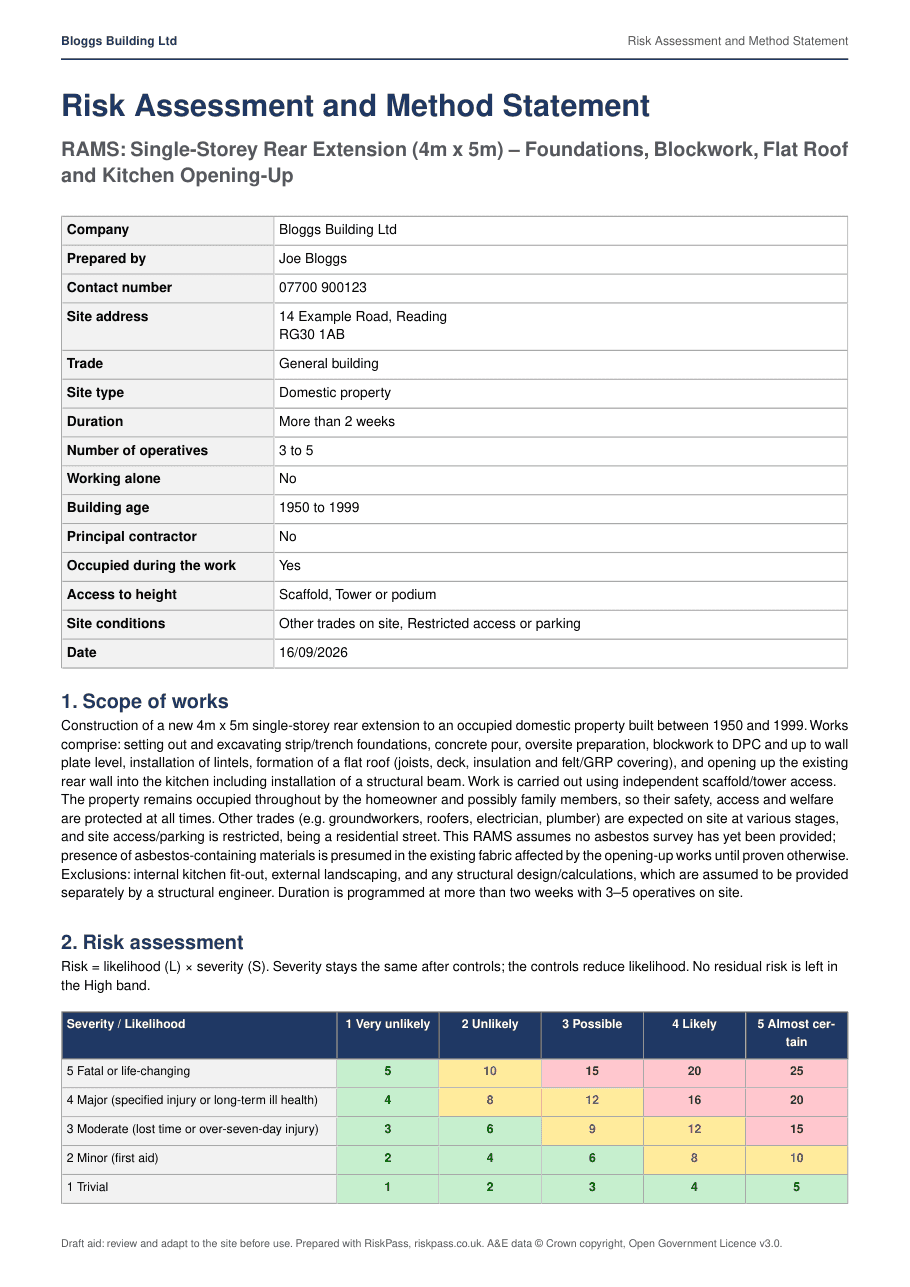
Cover and scope
Your details and your answers come from the form, not from the model, so the cover is always right — and a wrong answer is there to be spotted.
Risk assessment
Landscape, so the controls have room. Scores are colour-banded, and the residual is always lower than the initial.
Method statement
In the order the work is done, with the safety check built into each step.
Briefing and sign-off
Twelve rows for the operatives to sign on site, which is what a briefing record is for.
That is the whole of it
No account to make, nothing to cancel, and you see most of a document before deciding.
£29 when you unlock it. Nothing to pay until you have read the preview.